


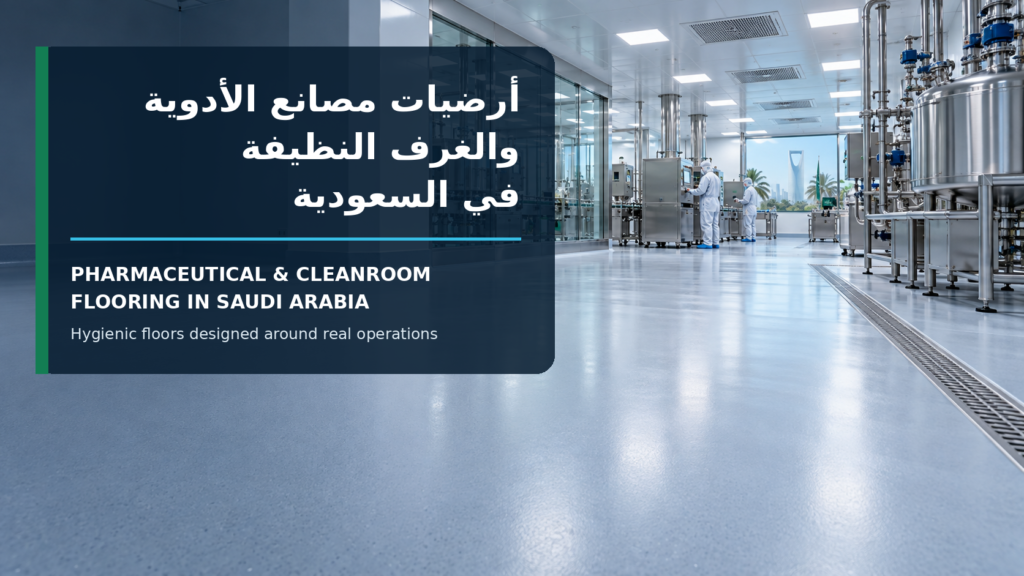
Pharmaceutical & Cleanroom Flooring in Saudi Arabia: A Zone-by-Zone Specification Guide
In a pharmaceutical facility, the floor is part of the controlled production environment. A poorly selected system can introduce difficult-to-clean joints, premature coating failure under disinfectants, slippery wash zones and repeated shutdowns for repairs. The specification must therefore begin with how each room operates, not with a generic product name.
Saudi Floors supports pharmaceutical factories, laboratories, packaging areas and controlled warehouses in Riyadh and across Saudi Arabia. The process covers concrete assessment, surface preparation, detailing and installation of a system selected for the actual traffic, cleaning regime, exposure and downtime available.
Why Pharmaceutical Facilities Need a Dedicated Flooring Specification
A packaging hall does not have the same risks as a cleanroom, raw-material store, wet utility area or quality-control laboratory. Some zones prioritize a smooth, impervious and cleanable finish. Others need defined slip resistance, chemical resistance, impact strength or tolerance of frequent washing.
EU GMP Annex 1 states that exposed surfaces in cleanrooms and critical zones should be smooth, impervious and unbroken to minimize particle shedding or accumulation and permit repeated cleaning and disinfection. This performance does not come from the resin name alone. It depends on substrate condition, system build-up, transitions, joints, drains, installation control and the facility cleaning programme.
Technical reference: European Commission – EU GMP Annex 1
Performance Requirements to Define Before Product Selection
- A non-porous, cleanable surface without dirt-trapping defects.
- Resistance to the actual cleaners, disinfectants and process chemicals at their working concentrations and temperatures.
- Slip resistance appropriate to dry, wet and transition zones.
- Capacity for trolley traffic, equipment loads, abrasion and impact.
- Low dust and particle generation in controlled environments.
- Hygienic coved transitions at walls, columns, plinths and equipment bases.
- A repair and return-to-service strategy compatible with the shutdown window.
- Color zoning for personnel flow, materials, hazards and restricted areas.
Map the Facility Before Choosing the System
A zone schedule directs the budget toward the real risks. It prevents a light-duty coating from being installed in a harsh process area and avoids unnecessary over-specification in low-demand rooms.
| Operational zone | Flooring priority |
| Cleanrooms and critical zones | Seamless, smooth, low-emission and cleanable finish with precise edge details |
| Processing and compounding | Resistance to identified chemicals, washing, impact and movement |
| Packaging | Cleanability, trolley traffic and task-appropriate slip resistance |
| Quality-control laboratories | Continuous finish and specific chemical resistance |
| Pharmaceutical warehouses | Rack and trolley loads, joint durability and dust control |
| Corridors and service routes | Abrasion resistance, visible zoning and maintainability |
| Wash and utility areas | Falls, drainage, wet slip resistance and compatible cleaning resistance |
Epoxy, Polyurethane Cement or a Zoned Combination?
Industrial epoxy systems
Epoxy can create a seamless surface with adjustable thickness, color and texture. It may suit laboratories, packaging rooms, corridors and selected process areas when the substrate is properly prepared, moisture is assessed and the formulation is compatible with the real exposure.
Polyurethane cement systems
These systems may be evaluated for areas exposed to more frequent washing, thermal variation or demanding process conditions. Product data and chemical-resistance information must still be checked against the facility’s actual disinfectants and chemicals.
Zoned system design
A project may use a smooth controlled-environment finish in cleanrooms, a more textured system around wash zones and a traffic-resistant solution in storage. One specification throughout the building can either waste budget or leave critical zones underprotected.
Review the broader range of Saudi Floors services when building the zone schedule.
Details That Often Decide Whether the Floor Succeeds
- Coved skirtings create a cleanable transition between floor and wall.
- Drains and falls must be coordinated before installation to prevent standing liquid.
- Joints require a strategy consistent with slab movement, hygiene and traffic.
- Equipment bases, bolts and pipe penetrations must not leave weak edges or dirt traps.
- Thresholds need level, durable transitions for carts and cleaning equipment.
- Traffic and safety markings should follow the approved material and personnel flow.
Common Causes of Failure in Pharmaceutical Flooring
Failure often begins below the visible finish: unmeasured moisture, weak concrete, contamination, inadequate mechanical preparation, insufficient thickness, poorly detailed drains or traffic before the specified cure. A reliable scope should state preparation, repairs, system build-up, thickness, details and return-to-service conditions.
A Practical Delivery Sequence
- Collect operational data for each zone, including chemicals, cleaning, temperatures, traffic and shutdown limits.
- Survey concrete strength, moisture, cracks, joints, flatness and contamination.
- Create a room-by-room performance schedule.
- Approve a mock-up showing color, texture, coved details and cleanability.
- Mechanically prepare the substrate and complete repairs.
- Install under controlled site conditions and observe intercoat and cure times.
- Inspect, document zones and hand over cleaning and maintenance guidance.
What Determines Pharmaceutical Flooring Cost in Saudi Arabia?
Area alone is not enough for accurate pricing. Cost is affected by concrete condition, the number of operational zones, thickness, chemical resistance, slip profile, coves, equipment and drain details, phased working, shutdown constraints and project location in Riyadh, Jeddah, Dammam or other industrial cities.
A comparable quotation should identify substrate preparation, repairs, system type, thickness, layers, detail work, inspection or acceptance criteria, duration and exclusions rather than presenting only a square-meter rate.
Information to Send Before the Site Assessment
- Project city and facility location.
- Room schedule and approximate area of each zone.
- Existing floor condition with close and wide photographs.
- Cleaners, disinfectants, process chemicals and frequency of exposure.
- Operating temperatures, wash water and drainage conditions.
- Personnel, trolley and equipment traffic with expected loads.
- Required cleanliness classification or project-specific performance documents.
- Programme, installation date and maximum shutdown window.
Request a Zone-Based Flooring Proposal
Saudi Floors can help turn a general material request into a room-by-room flooring scope. Send the layout, areas, photographs, cleaning requirements and shutdown limits for an initial review, followed by a site visit and detailed quotation where required.
Start here: contact Saudi Floors for an assessment and quotation
Frequently Asked Questions
What is the best flooring for a pharmaceutical factory?
No single system suits the entire facility. Cleanrooms, processing, laboratories, warehouses and wash zones require different performance levels.
Is epoxy suitable for cleanrooms?
It can be suitable when a documented low-emission system is installed as a continuous, correctly detailed surface. Final acceptance depends on room classification and project requirements.
Does a smooth floor become slippery?
Some smooth finishes can be slippery when wet. Cleanability and slip resistance must be balanced for each operational zone.
Can resin flooring be installed over existing tiles?
Only after assessment of tile adhesion, joints, moisture, levels and contamination. Removal or special preparation may be necessary.
Why is concrete moisture testing important?
Moisture movement can cause blistering or loss of adhesion in some systems. Test method and acceptance limits should follow the selected flooring specification.
Is any floor resistant to every chemical?
No. Chemical type, concentration, temperature, exposure duration and cleaning procedure must be defined and checked against system data.
How long does installation take?
It depends on area, preparation, system, detailing and cure. Phased installation can reduce disruption.
Does Saudi Floors work outside Riyadh?
Saudi Floors supports projects across the Kingdom. Logistics and programme are confirmed according to city, area and site requirements.