


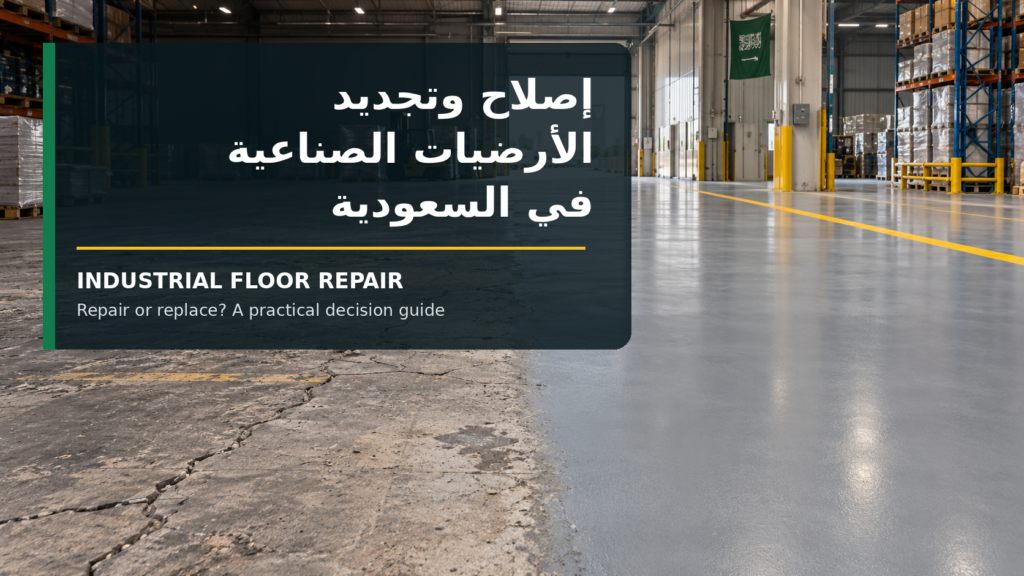
When forklifts begin to vibrate over damaged joints, coatings peel repeatedly, or cleaning takes longer because the surface is pitted, floor damage has become an operational issue. Yet complete demolition is not always necessary. The right decision starts with identifying whether the defect is limited to the finish, extends into the concrete slab, or reflects a mismatch between the existing system and current operations.
Saudi Floors supports factories, warehouses, logistics centers, parking facilities and commercial projects in Riyadh and across Saudi Arabia. This guide helps facility owners prepare for a technical assessment and obtain a quotation based on actual floor condition, risk and downtime constraints. Industrial Floor Repair
Warning Signs That Require a Floor Assessment
- Peeling, blistering or delamination of an epoxy coating.
- Cracks that widen or return after previous repairs.
- Broken joint edges under repeated forklift traffic.
- Pits or depressions that collect wash water.
- Persistent dusting from an untreated or weak concrete surface.
- Loss of slip resistance on ramps or wet-process areas.
- Oil or chemical contamination that has penetrated the surface.
- Worn traffic lanes, pedestrian routes and safety markings.
These symptoms do not identify the cause on their own. Peeling may result from moisture, insufficient preparation or a coating that does not suit traffic and chemical exposure. Covering the visible defect without correcting the cause can lead to another failure.
Diagnose Before Selecting a Repair Product
A useful survey distinguishes a finish failure from a concrete, joint or sub-base problem. The assessment should consider the percentage of affected area, concrete soundness, crack pattern, moisture, oil contamination, loads, wheel type, chemicals, cleaning methods and the shutdown window. Active or structural movement may require an engineer before a new finish is specified.
When Is Localized Repair Appropriate?
Localized repair may be suitable when the slab is stable, damage is limited and the surrounding system remains well bonded. Work can include routing and treating cracks, rebuilding joint arrises, patching pits, removing loose coating and reinstating compatible layers. This option limits the work area and initial downtime, but it should not be used to disguise widespread loss of adhesion or a recurring moisture problem.
When Should the Floor Be Resurfaced?
Resurfacing is often the better choice when the structural concrete remains serviceable but the finish is worn, inconsistent or no longer matches operational requirements. Weak material is removed mechanically, defects are repaired and a new system is installed. Depending on the facility, the solution may be industrial epoxy, a textured finish for wet zones, or concrete grinding, densifying and polishing where the slab is suitable.
Compare finishes in the Saudi Floors guide to industrial epoxy and polished concrete.
When Is Full Replacement More Economical?
Replacement should be evaluated when defects are widespread, the slab cannot support new loads, contamination is deep, settlement has occurred, or the facility now requires performance the existing construction cannot provide. Replacement may include removal of the old system, concrete reconstruction, revised drainage or falls, joint redesign and installation of a new finish. For new large slabs requiring controlled levels, laser screed execution can be considered as part of the complete design.
Repair Decision Comparison
| Decision | Best fit | Main benefit | Key consideration |
| Localized repair | Limited defects; stable slab | Lower downtime and initial cost | Patches may remain visible |
| Full resurfacing | Sound slab; worn finish | Consistent performance and appearance | Requires thorough mechanical preparation |
| System replacement | Widespread failure or changed use | Addresses underlying limitations | Higher cost and longer planning window |
How Can Downtime Be Reduced?
A floor refurbishment should be planned as an operational project, not simply a coating task. The area can often be divided into phases, alternative routes created and high-risk zones scheduled during maintenance periods. Return-to-service time must reflect the selected material and actual site temperature and humidity. Traffic should not resume before the system has reached the required cure.
Project logistics differ across Riyadh, Jeddah, Dammam and industrial cities. Access restrictions, heat, operating hours and safety procedures should be included in the scope before pricing.
What Determines Industrial Floor Repair Cost in Saudi Arabia?
- The damaged area and its percentage of the total floor.
- The existing system, thickness and removal method.
- Concrete strength, moisture, contamination, cracks and joints.
- Required resistance to slip, chemicals, impact and abrasion.
- Safety colors, markings and traffic zoning.
- Project location and access for preparation equipment.
- Phased or out-of-hours working.
- Required return-to-service time.
For a broader cost comparison, read Industrial Flooring Cost in Saudi Arabia.
Information Needed for a More Accurate Quotation
- Project city and location.
- Facility type and daily operation.
- Total area and estimated damaged area.
- Close and wide photos, plus a traffic-route video if available.
- Equipment loads, forklift type and wheel material.
- Water, oils, cleaners and chemicals present.
- Operating hours and maximum available shutdown.
- Required color, texture, slip resistance and markings.
A site survey can then confirm the repair boundary, preparation method, selected system and work phases. A useful quotation identifies included repairs, preparation, thickness, layers, joint treatment, duration and exclusions instead of presenting only a generic square-meter rate.
Request a Floor Assessment
If your factory or warehouse floor has cracks, peeling, pits, worn lanes or damaged joints, send Saudi Floors the city, approximate area, photos and operating conditions. The team can evaluate whether localized repair, full resurfacing or system replacement is the appropriate next step and prepare a scope aligned with your operation and budget.
Request a consultation and quotation
Frequently Asked Questions
Can peeling epoxy be repaired without removing the entire floor?
Yes, when delamination is limited and the surrounding coating and concrete are sound. Widespread moisture or adhesion failure may require larger-scale removal and resurfacing.
How long does industrial floor repair take?
Duration depends on area, defect type, preparation, material and cure time. Phased work can often reduce operational disruption.
Can repairs be completed in an operating warehouse?
Often yes, using isolated work zones, alternative routes and a safety plan. Traffic must remain off each area until preparation and curing are complete.
Does every concrete crack require floor replacement?
No. The crack must be classified as stable or moving and assessed in relation to joints, loading and settlement before a repair method is chosen.
What is the best flooring system for a factory?
There is no universal system. Loads, traffic, chemicals, washing, temperature, slip resistance and concrete condition determine the specification.
Can new epoxy be applied over old epoxy?
Only after confirming that the existing system is well bonded and compatible, followed by suitable mechanical preparation. Loose layers must be removed.
What information is needed for pricing?
Provide location, area, photos, facility use, loads, chemicals and the available shutdown window. Complex projects still require a site assessment.
Does Saudi Floors work outside Riyadh?
Saudi Floors supports projects across Saudi Arabia. Execution scope and logistics depend on city, project size and operational requirements.